


Find the Cheapest Days to Fly and Save Big
If you want to master the art of finding cheap flights, you need to learn one simple rule: fly on a Tuesday or Wednesday. This is the most consistent and effective way to lower your airfare.
Why does this work? It’s all about supply and demand.

Actionable Insight: Fly Midweek to Avoid Peak Demand
Think about who flies and when. Fridays and Sundays are packed with weekend travelers, while Mondays are filled with business travelers starting their work week. This high demand drives up prices significantly.
In contrast, Tuesdays and Wednesdays are the quietest days at the airport. Airlines hate flying planes with empty seats, so they drop their prices on these off-peak days to encourage more bookings.
This isn't just a travel myth; it's a proven strategy. By simply shifting your travel days to the middle of the week, you can find much better deals.
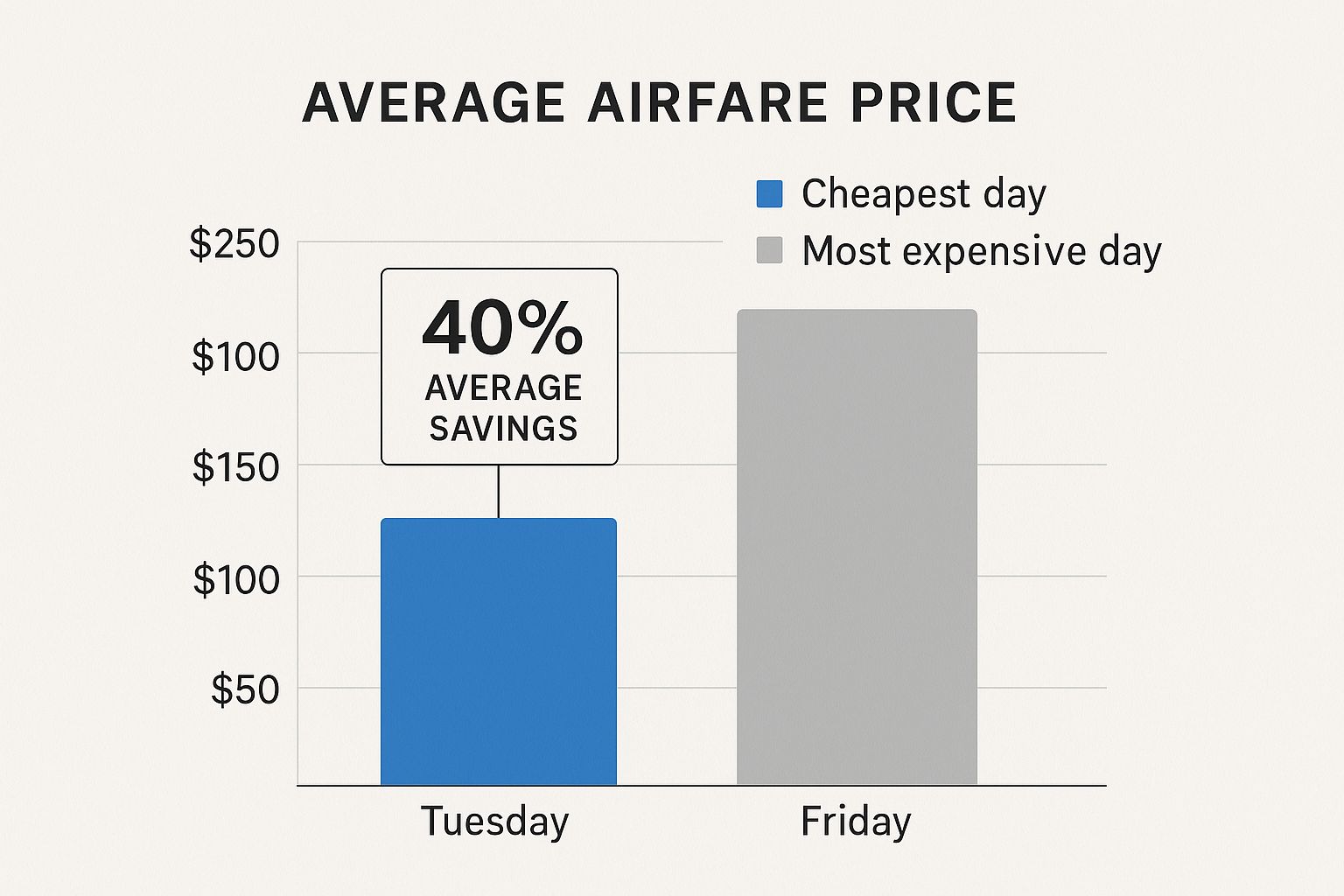
As the data shows, the savings are substantial. Choosing a Tuesday flight over a Friday one could reduce your ticket price by up to 40%. That’s money you can use for better accommodation, activities, or another trip entirely.
To make this crystal clear, here’s a breakdown of how the week typically looks for domestic flight pricing.
Weekly Flight Price Trends At A Glance
Use this table to plan your travel around the most expensive days and target the cheapest ones.
Day of the Week | Typical Price Level | Your Action Plan |
|---|---|---|
Monday | High | Avoid if possible |
Tuesday | Low | Target this day |
Wednesday | Lowest | Target this day |
Thursday | Moderate to High | Fly if you can't do mid-week |
Friday | Highest | Avoid at all costs |
Saturday | Moderate | A decent alternative |
Sunday | High | Avoid if possible |
This pattern highlights why the Tuesday/Wednesday window is your golden ticket. You are strategically choosing to fly when demand is at its absolute lowest.
Actionable Insight: Use Flexibility as Your Primary Tool
To take advantage of these midweek deals, you need to be flexible. If you can shift your trip by a day or two, you unlock the best prices.
Before setting your vacation dates in stone, search for flights using a flexible date calendar. Instead of a default Friday-to-Sunday trip, price out a Wednesday-to-Tuesday itinerary. The price difference will often be dramatic.
How to Apply This: Always travel when others don't. By avoiding peak travel days like Friday and Sunday, you sidestep the highest demand and the most expensive fares.
Mastering this single concept is the most important step toward becoming a savvy traveler. To see real-world examples of this strategy, explore how flexible travel dates can save you hundreds on airfare. It demonstrates how a small adjustment to your schedule can result in massive savings.
How Airlines Price Your Flight Ticket
Have you ever searched for a flight, refreshed the page a minute later, and seen the price increase? It’s not a glitch. Airlines use a complex system called revenue management to maximize their profit on every single flight.

Think of an airline seat as a perishable item. Once the plane door closes, an empty seat is worth nothing. The airline’s objective is to sell every seat for the highest possible price.
To achieve this, their algorithms categorize travelers into two main groups:
Leisure Travelers: You're likely planning a vacation, flexible on dates, booking in advance, and highly price-sensitive. You're looking for a deal.
Business Travelers: They often book last-minute, have rigid schedules, and are less concerned with price because the company is paying.
Actionable Insight: Book Early to Beat the Algorithm
To cater to both groups, airlines create different fare buckets for the same economy seat. They release a limited number of cheap seats months in advance to attract leisure travelers and start filling the plane.
Once those low-fare seats are sold, prices automatically begin to rise. The airline's algorithm predicts that as the departure date nears, only business travelers will be left, and they will pay the higher fares. This is precisely why booking early is a reliable way to save money.
How to Apply This: Understand the airline's goal. They want to sell cheap seats early without leaving no room for last-minute, high-paying business travelers. Book in the "prime window" to get the leisure fare before it disappears.
Understanding this system is your advantage. When you know how airlines set prices, you can anticipate their moves and find significant savings—all while avoiding hidden costs like airline junk fees and how to avoid charges.
Your Best Time to Book a Flight
Knowing the cheapest days to fly is crucial, but when you book is just as important. Nailing the timing is how you secure the lowest possible fares. Forget the myths about booking on a Tuesday at midnight; the real strategy is booking within the "prime booking window."

Think of this window as the sweet spot. If you book too far in advance, airlines haven't released their best deals. If you wait too long, the cheap seats are gone, and prices skyrocket.
Actionable Insight: Identify and Book Within the Prime Window
For domestic flights, the prime booking window is typically one to three months before your travel date. During this period, airlines have a good sense of demand and compete for passengers, leading to lower prices.
For international flights, plan further ahead. The sweet spot is generally two to eight months in advance. This longer timeframe allows you to track fare fluctuations and buy when the price drops. Booking in this window is especially important when you need to learn how to book affordable flights during peak seasons.
How to Apply This: Avoid booking at the last minute or a year in advance. For domestic trips, set a calendar reminder to start seriously searching three months out. For international, start looking eight months ahead.
Data from Oafare Flights confirms that how far in advance you book is more important than the specific day you buy your ticket. The analysis shows that price differences between booking on a weekday versus a weekend are minimal. The same research identified specific windows for certain destinations, noting that the lowest fares for Caribbean flights often appear around 44 days before departure.
The Surprising Weekend Booking Advantage
Here's a counterintuitive tip that can save you money: buy your flight on a weekend. While Sunday is one of the most expensive days to fly, data shows it's often one of the cheapest days to book your ticket.
This reveals a critical distinction: the day you fly is different from the day you buy. Confusing the two is a common mistake. Airlines know that leisure travelers—who are the most price-sensitive—do their travel planning on weekends.
To capture this audience, airlines frequently launch sales on Fridays or Saturdays. This creates a brief opportunity to find lower fares while everyone else is offline.
Actionable Insight: Separate Your Travel Day from Your Purchase Day
This isn't just speculation; it's backed by data. An analysis of airline pricing found that tickets purchased over the weekend were, on average, 5% cheaper than those bought during the week. This indicates a clear airline strategy: target different buyers at different times.
How to Apply This: Stop thinking about flying and booking on the same day. Use your weekdays to plan and your weekends to purchase. While others avoid Sundays for flying, use it as your dedicated day to search for and book the best deals.
This trend is consistent across the industry. Major travel reports also identify Sunday as a prime day to find lower prices. You can learn more about how travel days impact flight costs to refine your strategy. By shifting your booking habits to the weekend, you add another powerful money-saving technique to your toolkit.
Actionable Tips to Always Find Cheaper Flights and Cheapest days to fly
You now understand the best days to fly and the best time to book. Let's translate this knowledge into a practical checklist you can use every time you search for a flight to guarantee you save money.

The single most important takeaway is this: flexibility is your greatest asset. Shifting your travel dates by just a day or two to fly on a Tuesday or Wednesday can cut your ticket price by 40% or more.
Before you request time off work, use a fare calendar to compare prices on the days surrounding your ideal dates. The savings you find might surprise you.
Master Your Flight Search Strategy
Beyond date flexibility, use these smart search tactics to find fares that others miss.
Set Price Alerts: This is non-negotiable. Use tools like Google Flights to set alerts for your desired route. You’ll get an email when the price drops, allowing you to book the deal without constantly checking websites.
Check Nearby Airports: Always check for smaller, alternative airports near your destination. Flights into these airports are often significantly cheaper than major international hubs.
Mix and Match Airlines: Don't assume a round-trip ticket on one airline is the cheapest option. Search for two one-way tickets on different airlines; this can often result in a lower total cost.
How to Apply This: Your goal is to build a smarter travel plan, not just find a single cheap flight. Combine flexible dates, price alerts, and alternative airports to maximize your savings.
Consider the Total Cost of Your Trip
A cheap flight is a great start, but it's only one part of your travel budget. Always consider the total cost of your trip.
For instance, a cheap flight to a distant airport might be negated by a costly taxi or train ride into the city. Factoring in expenses like finding affordable airport transfers will give you a true picture of your travel costs.
Ultimately, finding cheap flights is about developing smart habits. For a deeper dive, read our complete guide on how to find the best deals on airfare. Use these strategies consistently, and you'll never pay full price for a flight again.
Common Questions About Finding Cheap Flights
Even with the best strategies, specific questions often come up during the booking process. Here are direct answers to the most common queries so you can book your next flight with confidence.
Are Last-Minute Flights Ever Cheaper?
Rarely. While stories of incredible last-minute deals exist, they are the exception. In almost all cases, waiting until the last minute will cost you more. Airlines increase prices significantly in the final two weeks before departure to capitalize on business travelers and urgent flyers who have no choice but to pay. Your best strategy is to book within the prime window: 1-3 months in advance for domestic flights.
Does the Time of Day I Fly Matter?
Yes, absolutely. The first flight of the day (around 6 a.m.) and the last flight at night are often the cheapest. Why? Because they are less convenient for most travelers. Demand for these off-peak hours is lower, which means lower prices for you. In contrast, flights during prime business hours (mid-morning and late afternoon) are typically more expensive. If your schedule allows, choosing an early-morning or late-night flight is an easy way to save.
How to Apply This: When searching for flights, sort by price and look at the flight times for the cheapest options. If you can handle an early alarm or a late arrival, you can save a significant amount.
Should I Clear My Browser Cookies?
This is a long-standing travel debate. The theory is that airlines track your searches using cookies and may increase prices if they see you repeatedly checking a specific route. While there's no definitive proof this is a widespread practice, it costs nothing to be cautious. Actionable Step: Always search for flights in an incognito or private browser window. It’s a simple, zero-cost action that ensures you're seeing the baseline fare and could prevent potential price inflation.
Ready to put these tips into action? Find your next great deal with Oafare, Inc. by visiting https://www.oafare.com to compare hundreds of flights and save.


Comments