


How to Find Cheap Flights: Your Action Plan to Save Big on Airfare
The single most effective strategy for finding ridiculously cheap flights is this: be flexible. When you're not locked into specific dates, times, or even airports, you gain all the power. This isn't just a minor tip; it's an actionable plan for outsmarting airline pricing and saving a ton of cash.
Master Flexibility to Unlock Lower Fares
The secret to consistently landing cheap flights isn't a magic booking window or a hidden website. It's about becoming the type of traveler airlines need—the person who can fill an undesirable seat. Airline pricing is a game of supply and demand, and demand skyrockets for the most convenient travel schedules.
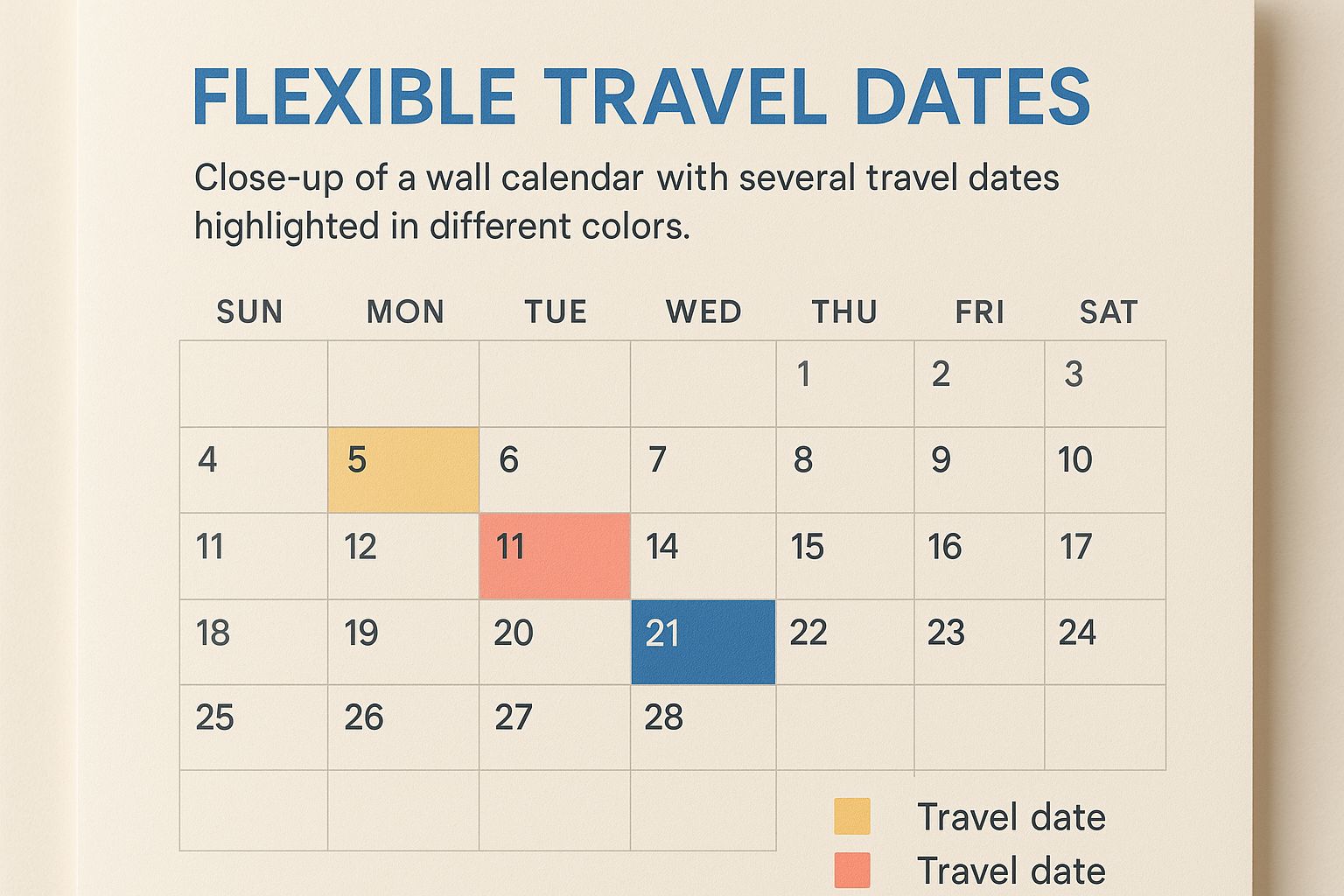
By stepping outside those patterns, you sidestep the highest prices. The first step? Ditch the weekend mindset and learn to travel mid-week.
Action #1: Fly on a Tuesday or Wednesday
Most people fly out on a Friday and return on a Sunday to maximize their weekend without using vacation days. Airlines know this and hike prices accordingly.
Your move is to target Tuesdays and Wednesdays. These days see a significant dip in both business and leisure travel, leaving airlines with empty seats. To fill them, they drop the fares. Shifting your flight from a Friday to a Tuesday could cut your fare by 12–15% on international routes. That's a huge discount for a simple schedule change. For a closer look at how airlines price their tickets, check out our guide on mastering last-minute travel planning.
Action #2: Book an Undesirable Flight Time
The same logic applies to the time of day you fly. Flights during the morning rush (8-10 AM) or evening commute (5-7 PM) are almost always the most expensive because they're the most convenient.
To find the real bargains, you must target the edges of the day.
Book Early Morning Flights: A 6 AM departure means a painfully early alarm, and most travelers will pay to avoid that. Their loss is your gain.
Book Late-Night Flights: Similarly, flights leaving after 9 PM are far less popular. Booking one can slash the price compared to a flight departing just a few hours earlier.
Your Takeaway: The more inconvenient a flight time seems to the average person, the cheaper it will be for you. This strategy alone can knock 10–20% off your fare.
Action #3: Search for Nearby Airports
Many big cities have more than one airport. While the main international hub gets all the attention, smaller airports are often serviced by budget airlines with lower operating costs—and those savings get passed on to you.
For example, when flying to the Bay Area, don't just search for San Francisco (SFO). Expand your search to include Oakland (OAK) and San Jose (SJC). You'll often find a major difference in pricing. Choosing a secondary airport can sometimes cut your ticket price by as much as 30%. To do this, simply check the "add nearby airports" box on your flight search engine.
Take a look at this Google Flights example. The flexible date grid makes it incredibly easy to see the cheapest days to fly over an entire month.

As you can see, the calendar view instantly shows how shifting your travel from a weekend to a mid-week date can save hundreds of dollars on this one route alone.
The Art of Timing Your Flight Purchase
Forget the myth about booking flights on a Tuesday. The real secret isn't what day you book, but how far in advance you buy. There is a "golden window" where airlines offer their most competitive prices before demand drives them sky-high.
Timing your purchase is a powerful strategy for locking in a cheap flight. Booking too early can be as costly as booking last minute. Airlines often set initial fares high, then adjust them based on how quickly seats sell.

Here's how to get a serious advantage: understand the airline pricing game and swoop in at the right moment—after the initial high prices but before the last-minute surge.
Action #4: Book Within the "Sweet Spot"
So, when is this booking window? It depends on your destination. Domestic and international routes have different timelines.
For domestic travel, the sweet spot is generally 6 to 8 weeks before your departure date. This is when airlines have a good read on demand but still need to fill seats, resulting in better prices for you.
For international travel, you need to plan further out. The best deals typically appear around 10 to 11 weeks before departure. Airlines manage these complex routes on a much longer timeline.
Booking inside these windows can lead to significant savings. For instance, a 2023 analysis found that U.S. domestic flights bought in the sweet spot averaged $287, a solid discount from the $350 average for last-minute bookings. In Europe, the savings can reach up to 25% during peak travel seasons. These numbers prove it: timing is everything.
Action #5: Avoid the Last-Minute Price Spike
One of the most predictable airfare patterns is the massive price jump in the final three weeks before a flight. This is a deliberate airline strategy.
Airlines know that last-minute bookers are often business travelers or those with emergencies. These travelers are less price-sensitive and will pay whatever it takes.
By waiting until the last three weeks, you place yourself in the same category as the least price-conscious travelers. Prices can easily double or triple in this final window.
Think of it as the procrastination penalty. The easiest way to find a cheap flight is to book well outside this high-cost zone.
A Practical Calendar for Your Purchase
Let's make this actionable. Imagine you’re planning a trip for the first week of June. Here’s how to apply these timelines:
International Trip (NYC to Paris): To hit the 10-11 week sweet spot, start searching and be ready to book around mid-March.
Domestic Trip (NYC to Miami): For a domestic getaway that same week, your ideal booking window is between the beginning and middle of April.
Set a calendar reminder now so you don’t miss these windows. And remember, while the day you book doesn't matter much, the day you fly still does. You can learn more in our article debunking the travel myths about the cheapest day to fly. Combine a smart booking timeline with flexible travel dates, and you’ll be perfectly positioned to snag an amazing deal.
Your Essential Toolkit for Finding Deals
Using the right tools transforms the hunt for cheap flights from a chore into a strategic advantage. It’s not about endlessly refreshing dozens of sites; it’s about knowing which tool to use for which job. This is your flight-finding workshop, where each platform serves a specific, powerful purpose.
Let's move beyond just listing websites and dig into the unique strengths of each. This approach helps you start your search broadly to spot trends and then narrow in with specialized tools to capture the absolute best deal.
Starting with the Heavy Hitters: Meta-Search Engines
Your first stop should always be a meta-search engine. These platforms don't sell flights; they act as powerful aggregators, scanning hundreds of airline sites and online travel agencies (OTAs) in seconds. This gives you a comprehensive overview of your options right from the start.
My go-to tools are Google Flights and Skyscanner. They excel at broad, flexible searches and have features designed to reveal the lowest prices when your plans aren't set in stone.
Google Flights: Its speed is incredible. Use the calendar view and "Explore" map to visualize price differences across an entire month or continent, making it perfect for initial brainstorming.
Skyscanner: Its key advantage is including many budget and regional airlines that other search engines miss. This is crucial for international trips, where a local low-cost carrier could save you hundreds.
The clean layout on Skyscanner makes comparing different carriers straightforward and painless.
Being able to see multiple airlines side-by-side like this allows for instant price comparisons, highlighting the most cost-effective routes immediately.
When to Use Online Travel Agencies (OTAs)
After finding a great fare on a meta-search engine, you might be directed to an OTA like Expedia to book it. While booking directly with the airline is often better for customer service, OTAs can offer exclusive deals, especially when you bundle your flight with a hotel or car rental.
Package deals are where OTAs shine. Airlines provide discounted bulk fares to these agencies, which they can then pass on to you when you book multiple parts of your trip together. Use this strategy for all-in-one vacation planning.
Unlocking Expert-Level Deals
For travelers serious about squeezing every last dollar of savings, a few specialized services are essential. These tools go beyond standard searches to uncover fares you simply won't find anywhere else.
Pro Tip: The biggest savings often come from deals you weren't even looking for. Specialized deal-finding services scour the web for mistake fares and unadvertised sales, bringing opportunities directly to your inbox.
[Going](https://www.going.com/) (formerly Scott's Cheap Flights): This subscription service does the hard work for you. Their experts find mistake fares—prices published by airlines in error—and incredible sales, then email them to members. It's a passive way to find deals like a $350 round-trip to Paris that you'd never discover on your own.
[Matrix ITA Software](https://matrix.itasoftware.com/): This is the powerful engine behind Google Flights, offering more advanced filtering options for power users. While you can't book directly on Matrix, you can build complex itineraries and then use the details to book with the airline. It's the ultimate tool for fine-tuning a multi-city trip.
Comparison of Top Flight Finding Tools
To help you decide which tool to use and when, here is a quick comparison of these platforms. Knowing their strengths will make your search much more efficient.
Tool Name | Best For | Key Feature | Pros | Cons |
|---|---|---|---|---|
Google Flights | Speed and flexible, date-agnostic searches | "Explore" map and calendar view | Unmatched speed, clean interface, great for initial research | Doesn't always show the smallest budget airlines or some OTAs |
Skyscanner | Finding the absolute cheapest option | Includes budget carriers and OTAs others miss | Comprehensive results, "Everywhere" search feature, good for international | Can sometimes show outdated prices that need refreshing |
OTAs (Expedia, etc.) | Bundling flights with hotels and cars | Package deals | Can offer exclusive discounts on bundles, one-stop-shop convenience | Customer service can be difficult if issues arise; book direct if possible |
Going (formerly Scott's Cheap Flights) | Finding "unicorn" deals you aren't looking for | Email alerts for mistake fares and massive sales | Uncovers incredible, unadvertised deals; saves time and money passively | Subscription-based; not useful for specific, immediate travel needs |
Matrix ITA Software | Power users building complex itineraries | Advanced, multi-variable search filters | Ultimate control over search parameters for customized, multi-leg trips | Cannot book directly, steep learning curve for beginners |
Your best strategy is to combine these tools. Start broad with Google Flights or Skyscanner to get a lay of the land, then drill down with specialized services if you're chasing an exceptional fare. Remember, applying savings strategies across your entire trip, like finding cheap luxury car rentals, can compound your savings and significantly reduce your overall travel costs.
Once you’ve mastered the basics—flexibility, timing, and tools—it’s time to use advanced tactics. The best deals aren't always on the front page of a travel site. They’re hidden, and you have to know a few tricks to find them.
These are the advanced strategies that can unlock serious savings, but they require a bit more effort.
First up is a simple but effective tactic: cover your digital tracks. Airlines and booking sites use browser cookies to track your searches. If you repeatedly search for the same flight, their systems might flag you as a serious buyer and slowly increase the price. This is a classic case of dynamic pricing.
The easiest countermeasure is to always search in your browser’s incognito or private mode. This simple keystroke stops cookies from being saved, giving you a fresh start every time. It’s not a guaranteed money-saver, but it costs nothing and can prevent you from seeing an artificially inflated price.
The Hidden City Ticketing Hack
Ready to get more aggressive? Let’s talk about "hidden city" ticketing. This is a clever—and risky—way to game the system.
The tactic is to book a flight with a layover in your actual destination city. Why? Because sometimes, an itinerary with a connection is cheaper than a direct flight to that connection city. You just get off the plane at the layover and skip the final leg.
For example, a direct flight from New York to San Francisco is $400. But you find a flight from New York to Seattle with a layover in San Francisco for just $250. You book the Seattle flight, get off in San Francisco, and walk out of the airport. You just saved $150.
A tool called Skiplagged is built specifically for finding these fares. But before you use it, understand the serious risks.
You can only bring a carry-on. Checked bags go to the final ticketed destination (Seattle, in our example).
This is a one-way strategy only. If you skip a leg on a round-trip ticket, the airline will cancel your entire remaining itinerary, including your flight home.
Airlines prohibit this. It's against their contract of carriage. While they likely won’t pursue a first-timer, frequent abusers could face penalties.
Hidden city ticketing is high-risk, high-reward. It’s for savvy, light-packing travelers who are fully aware that their plans could get complicated.
Booking One-Way Tickets Separately
Looking for a safer but still powerful strategy? Piece your trip together with separate one-way tickets. We're conditioned to think a round-trip ticket is always cheapest, but that’s an outdated assumption.
By mixing and matching airlines, you can often build a cheaper round trip. This works especially well on popular routes with competing budget carriers. You might find a great deal flying out on Spirit and an even better deal flying back on Frontier. A standard search might not show this combination.
Meta-search engines like Skyscanner or Kiwi.com are fantastic for this, as they are designed to show you these mix-and-match itineraries.
Let’s look at a real-world scenario:
You want to fly from Los Angeles (LAX) to Las Vegas (LAS).
A standard round-trip search on a major airline returns a fare of $220.
You search for two separate one-ways instead. You find an outbound flight on Southwest for $89.
You then find a return flight on a different day with Allegiant Air for $75.
By booking them separately, your total is just $164. That’s a $56 savings for a few extra minutes of searching. It’s a perfect example of how thinking outside the traditional round-trip box is key when learning how to find cheap flights.
Booking Smart to Avoid Hidden Costs
Scoring a cheap flight is great, but the real win is making sure it stays cheap. That eye-popping low fare can hide a minefield of extra charges that turn your bargain into a budget-buster. You must learn to book with a mindset that looks past the sticker price to the actual, total cost.
This is especially true with budget airlines. Their entire business model is built around luring you in with a low initial price and then piling on fees for everything else. It’s not uncommon for a $49 flight to become $150 or more once you add what you need.
Decoding the Real Price of Your Ticket
The first rule of smart booking is to always read the fine print before you buy. That amazing deal might not include things you take for granted. The trick is to anticipate these costs and mentally add them to the base fare to calculate your true "all-in" price.
Watch out for these common fees:
Baggage Fees: This is the big one. Most low-cost carriers charge for both checked bags and carry-on bags that go in the overhead bin. Usually, only a small personal item that fits under your seat is free.
Seat Selection: If you don't want to be stuck in a middle seat, you'll have to pay. Choosing your own seat can cost anywhere from a few dollars for a standard spot to a hefty sum for extra legroom.
Printing Your Boarding Pass: Some ultra-low-cost airlines will charge a fee to print your boarding pass at the airport. Always check in online and use the mobile app or print it at home.
Your Goal: Find the best overall value, not just the cheapest initial fare. A legacy airline's $200 ticket that includes a carry-on and seat selection might be cheaper than a budget airline's $120 fare plus $90 in mandatory fees.
When Loyalty Programs Make Sense
You might think airline loyalty programs are just for business travelers, but they can offer real savings for occasional vacationers. It’s almost always free to sign up, and the perks can help you dodge annoying hidden fees.
For instance, even the lowest level of airline status can sometimes grant you a free checked bag or priority boarding. Co-branded credit cards often pack similar benefits and let you earn miles on everyday spending that you can use for future flights. Don't dismiss them—a few minutes of research could save you a surprising amount of cash.
Of course, flight costs are just one piece of the puzzle. Avoiding unexpected baggage fees is huge. Brushing up on some clever smart packing strategies for international travel can help you travel lighter and cheaper.
Your Pre-Booking Checklist
Before you pull out your credit card, run through this quick mental checklist. This habit will save you from buyer's remorse when your "great deal" comes with surprise charges.
Calculate Your Total Baggage Cost: Have you added up the price for every single bag, both carry-on and checked? Fees are almost always lower if you pay online during booking.
Review Seat Fees: Are you okay with a randomly assigned seat, or do you need to pay extra to sit with your family? Factor that cost into your total.
Check Airport Location: Some budget airlines fly into smaller airports far from the city center. Make sure flight savings aren't eaten up by an expensive taxi or train ride.
Read the Rules: Look at the airline's policies on changes and cancellations. The cheapest fares are often completely non-refundable and non-changeable.
These extra charges, often called airline junk fees and avoid surprise charges, are a major headache for travelers. By being methodical and looking at the full picture, you can book with confidence, knowing you’ve actually locked in a genuinely good deal.
Got Questions? We’ve Got Answers.
Even with the best tools, booking flights can feel like a guessing game. It's normal to have questions. Let's clear the air and tackle some of the most common ones. Getting straight answers will give you the confidence to book smarter and snag those deals.
Is It Really Cheaper to Fly on a Tuesday or Wednesday?
Yes, this piece of travel folklore is true. Data consistently shows that Tuesday and Wednesday are the cheapest days of the week to fly.
Why? It’s all about demand. These mid-week days are unpopular for both business travelers and weekenders, so airlines drop prices to fill the plane. On the flip side, Fridays and Sundays are almost always the priciest days to fly, as that’s when everyone is trying to get away or head home.
Does Incognito Mode or a VPN Actually Make a Difference?
The jury is out on how much of a game-changer this is, but it can protect you from price hikes. Here’s the deal: airlines and booking sites use browser cookies to track your searches. If they see you repeatedly looking up the same flight to Paris, their algorithm might flag you as a serious buyer and slowly bump up the price. This is known as dynamic pricing.
Going incognito or using your browser’s private mode is a simple way to erase your tracks and see a clean slate of fares. A VPN can sometimes unlock lower prices by making it look like you're booking from another country where fares might be cheaper. It's not a guaranteed money-saver, but it costs nothing to try and can prevent you from getting overcharged.
The absolute worst time to book a flight? In the last three weeks before you plan to leave. Prices go through the roof as airlines cash in on last-minute business travelers and others who have no choice but to pay up.
Are Budget Airlines Always the Cheapest Option?
Not by a long shot. This is a trap that trips up even seasoned travelers. Budget airlines are brilliant at dangling an unbelievably low base fare—like a $39 flight—to get you hooked.
But their business model is built on fees. Before you book, do the math. Open a calculator and add up the real cost:
Bags: Most budget carriers charge for everything, including a standard carry-on.
Seats: Want to sit next to your partner? That'll be extra.
Printing a boarding pass: Some even charge for printing your pass at the airport.
Once you have that all-in price, compare it to a major airline. You might be surprised to find that a legacy carrier's fare, which often includes a carry-on and free seat selection, is a much better value—and a far more pleasant experience.
Ready to put this knowledge to the test? **Oafare, Inc.** cuts through the noise, pulling deals from hundreds of airlines into one simple search. Stop juggling a dozen tabs and start finding your next adventure with confidence. Start your search on Oafare today!
Article created using [Outrank](https://outrank.so)


Comments