


When Do Flight Prices Drop for the Best Deals?
- Shontika Wandick
- Oct 8, 2025
- 13 min read
Figuring out when to buy a flight can feel like playing the stock market. You watch the prices, hope for a dip, and try to avoid buying right before a massive price hike. But it doesn't have to be a guessing game.
While there's no magic crystal ball, there are definite patterns to how airlines price their seats. Airlines use complex algorithms to constantly adjust fares based on seat availability and demand. Your goal is to understand this rhythm and book when the data is on your side.
So, when do prices actually drop? Here's your action plan:
For domestic flights, start your serious search and aim to book 1–3 months before your departure date.
For international trips, give yourself more lead time and book 3–6 months in advance.
Travel during "shoulder seasons" (the time between peak and off-peak) to save up to 15%. Peak season travel can add 20% or more to your ticket cost.
Data from a major global airfare study backs this up, finding that the lowest prices for domestic tickets were found around 70 days before departure. If you wait until the last minute, you could see fares jump by 30% or more. For a deeper look at the data, NerdWallet has a great breakdown of these findings.
To make it even simpler, use this quick reference guide to nail your timing.
Quick Guide to Best Booking Windows
This table breaks down the ideal timeframes to book your flights, giving you a clear, actionable plan for different kinds of travel.
Flight Type | Optimal Booking Window | Actionable Tip |
|---|---|---|
Domestic | 1–3 months ahead | Set a calendar reminder 3 months out. |
International | 3–6 months ahead | Start tracking prices 6 months out. |
Shoulder Season | Varies by route | Target April/May and Sept/Oct. |
Sticking to these windows is your best bet for avoiding the highest fares and snagging a decent deal.
This infographic gives a great visual summary of these booking windows and how prices shift with the seasons.
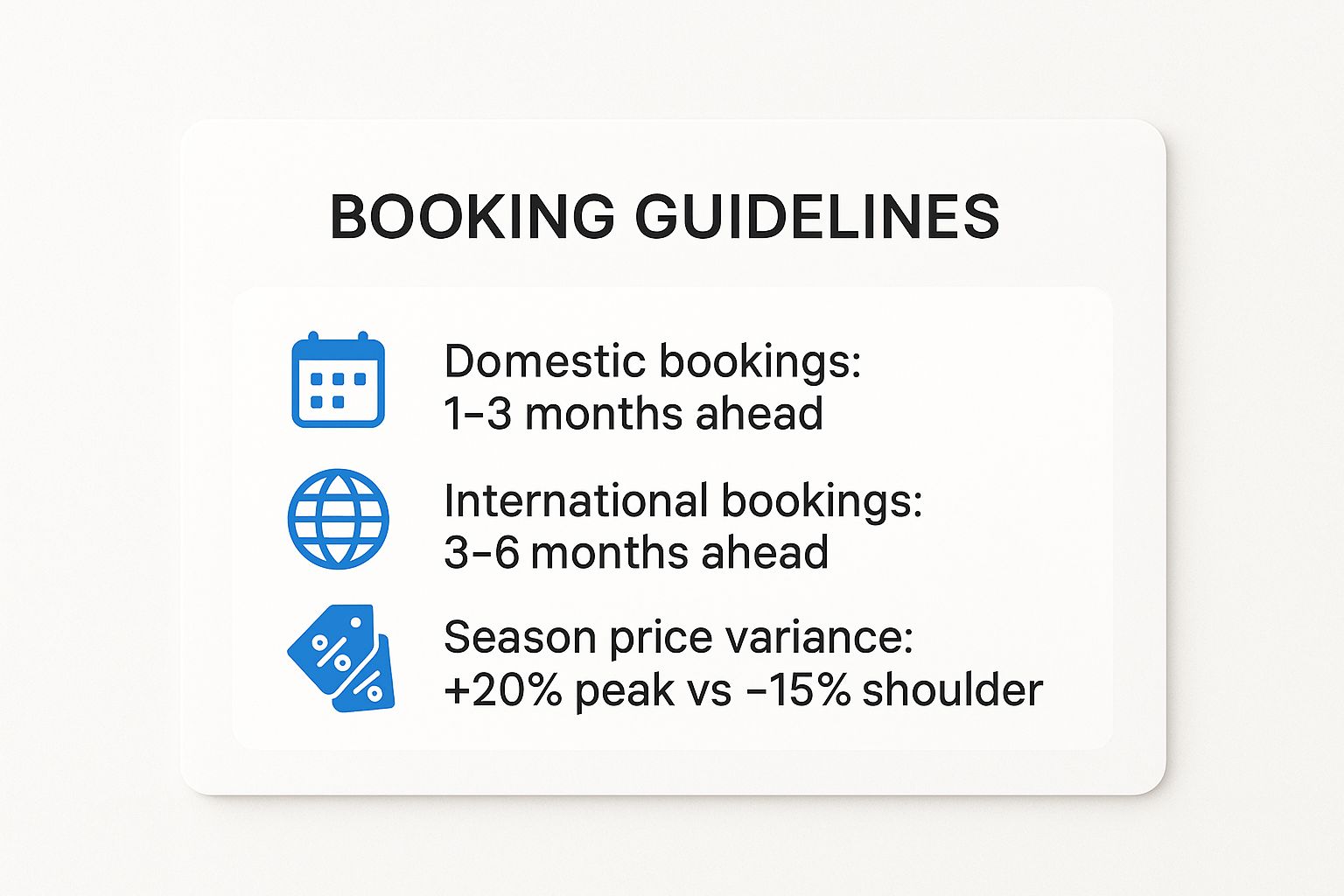
As you can see, timing is everything. Domestic fares tend to hit their low point around that 70-day mark, while international travel requires more foresight.
How Pricing Fluctuates With Timing
Airlines constantly tweak fares based on how quickly seats are selling. It's a non-stop dance between their inventory and our demand.
This means you need a two-pronged strategy: pay attention to the time of year and how far out you're booking. While there isn't one magical day of the week to book, you'll often see sales pop up mid-week—think Tuesday or Wednesday—as airlines release new deals after the weekend rush.
Whatever you do, avoid booking at the last minute. That's when prices can skyrocket, often by 20–30%.
Here’s a simple strategy to put this all into practice:
For international getaways, begin your search 3–6 months ahead of time.
For domestic trips, mark the 70-day point on your calendar and start tracking prices seriously.
Set up price alerts on a tool like Google Flights. This is the easiest way to get notified when a price drops without having to check constantly.
Once you start applying these principles, you'll move from gambling to making smart, strategic moves—which means more money in your pocket for the actual trip.
Mastering the Calendar for Cheaper Flights

To find the best deals, you need to sync your travel plans with the weekly and yearly rhythms of the airline industry. Use the calendar as your secret weapon to unlock serious savings.
One of the most reliable actions you can take is to change the day you actually fly. Business travelers typically fly out on Mondays and return on Fridays, and airlines price those days at a premium.
To save money, choose to fly on Tuesdays, Wednesdays, and Saturdays, as demand dips on these days. Shifting your travel dates by just one day can make a surprising dent in your final ticket price. For a deeper dive, you can learn more about how to find the cheapest days to fly and save big on your next trip.
Airlines also tend to roll out sales mid-week. By Tuesday, they've analyzed their weekend booking numbers and often launch new deals to fill empty seats. This creates a perfect window of opportunity for savvy travelers.
The Power of Seasonal Travel
Beyond the day of the week, the season has the biggest impact on flight prices. Airfare is a classic story of supply and demand, and prices skyrocket when everyone wants to go to the same place at the same time. Use this knowledge to your advantage.
Peak Season: Avoid booking during summer holidays, Spring Break, or Christmas if possible. Prices are at their absolute highest, and deals are rare.
Off-Season: This is the quietest time, like winter for a beach destination. You'll find the cheapest fares but may have to compromise on weather or attractions.
Shoulder Seasons: This is your target. Book your travel for spring (April-May) or fall (September-October) to get a fantastic balance of good weather, fewer crowds, and much lower flight prices.
Actionable Example: A round-trip flight to Rome in July (peak season) might cost $1,500. Book that exact same trip for late September (shoulder season) and the price could drop to $800. That's a huge saving just for shifting your travel dates.
When Airlines Adjust Their Prices
Finally, when you click "buy" also plays a role. Major flight trackers have confirmed that a "prime booking window" is a very real thing.
For domestic trips in the U.S. and Europe, booking about 6 weeks (42 days) before you plan to leave often hits the pricing sweet spot, potentially saving you up to 15%.
You'll often see prices drop on Tuesdays and Wednesdays as airlines adjust their fares for the week. The best deals tend to appear between Tuesday afternoon and Thursday morning. By layering this timing with your seasonal knowledge, you can master the calendar and stop overpaying for flights.
Why Flight Prices Constantly Change

Ever found the perfect flight, waited an hour to book, and returned to a higher price? This happens because airline fares are always moving. This isn't random; it's a deliberate strategy called dynamic pricing.
Think of it like selling tickets to a concert. Early seats are often priced lower to build buzz. As the date gets closer and seats fill up, prices climb. Airlines apply this same logic to thousands of flights every day.
The Forces Behind Price Swings
Airlines use complex algorithms that process dozens of data points in real time to set prices. These aren't wild guesses—they're calculated moves based on current market conditions. Understanding what drives these shifts is the first step to outsmarting the system and figuring out when flight prices drop.
Here are a few of the biggest factors to consider in your planning:
Route Competition: A route like New York to Los Angeles has many competing airlines, which helps keep prices down. A flight to a small town served by one carrier will likely be more expensive. Your move: Prioritize routes with more airline options.
Time and Day: Fares might tick up during lunch breaks or in the evenings when more people are searching. Your move: Search at different times of the day to spot variations.
Major Events: If there's a huge conference, festival, or Super Bowl in a city, flight prices will be sky-high. Your move: Check the city's event calendar before you book your dates.
Once you realize that prices are just reacting to real-world demand, you can go from being a passive buyer to a smart planner. You'll start looking for routes with healthy competition and booking your trips long before big events drive up demand.
Sudden, unexpected events can also cause prices to spike. For instance, airline strikes and their impact on flight availability and pricing can cause fares to jump overnight as available seats vanish.
The Bigger Economic Picture
Broad economic trends like the cost of jet fuel and general inflation also affect what you pay. These costs inevitably get passed on to travelers.
The changes can be dramatic. In early 2023, for example, fares shot up by a staggering 26.5% year-over-year due to high fuel prices and a surge in post-pandemic travel demand.
However, over the last decade, U.S. airfares have actually dropped by about 9.6% when adjusted for inflation. This shows how complex long-term trends are. While you can't control the global economy, you can absolutely control your timing to catch those price dips.
Actionable Strategies to Catch Price Drops

Knowing why airfares drop is one thing, but actually catching a deal requires a proactive strategy. It’s time to move from passively searching to actively hunting for savings.
The secret is to let the deals come to you while being ready to book the moment the price is right.
Let the Deals Come to You
Your first and most effective tool against overpaying is the price alert. Instead of manually checking fares every day, automate the process and get a notification the second a price changes.
Use tools like Google Flights or Skyscanner. Enter your desired route and dates, and find the "Track prices" toggle. Switch it on, and you’ll get emails whenever the fare for that itinerary moves up or down.
This simple action transforms your search from a daily chore into a strategic waiting game where you have the advantage. You can track multiple trips at once, giving you a complete view of the market without any heavy lifting.
The Power of Flexibility
If there’s one enemy of a cheap flight, it’s a rigid travel plan. Being flexible, even by a day or two, opens up a world of savings. Airlines know exactly when people want to fly—weekends, holidays, school breaks—and they increase prices accordingly.
A small adjustment can make a huge difference.
Be Flexible with Dates: Always use the calendar or date grid view on flight search engines. You'll instantly see how flying a day earlier or later can slash your fare. For instance, a Friday flight from Chicago to Orlando might be $250, but the same flight on the Wednesday before could be just $150.
Check Nearby Airports: Big cities often have multiple airports. A flight into a smaller, secondary airport like Burbank (BUR) instead of Los Angeles (LAX) or Fort Lauderdale (FLL) instead of Miami (MIA) can sometimes be dramatically cheaper. Always check the "include nearby airports" box when you search.
Your Action: Being flexible isn't just about saving a few bucks. It's about shifting the supply-and-demand equation in your favor. When you're willing to fly on a Tuesday morning or from an alternate airport, you're targeting a flight with less competition—and that almost always translates to a lower price.
Advanced Booking Tactics
Once you’ve mastered the basics, use these advanced tactics to find even bigger discounts. These take a bit more effort, but the payoff can be huge. For a deeper dive, check out our complete guide on how to find cheap flights.
Book Two One-Way Tickets: Don't assume a round-trip ticket is the best deal. Sometimes, booking two separate one-way tickets on different airlines is cheaper, especially if budget carriers fly part of your journey.
Check Airline Websites Directly: Search engines are great for comparison, but airlines sometimes run exclusive flash sales or offer promo codes only on their own sites. Always do a final check before you book.
Navigate Budget Airline Fees: That $49 flight looks great until you add fees for a seat, a carry-on, and checked luggage. Always calculate the total cost to ensure your "cheap" ticket is actually a good value.
Common Flight Booking Myths Debunked
Navigating the world of flight booking means wading through a swamp of bad advice. Old-school tips and stubborn travel myths can cost you serious money.
Let's clear the air. Getting a good deal isn't about a secret trick. It's about understanding how airlines actually price their seats and ignoring the fiction.
The Last-Minute Deal Myth
This is the most damaging myth: the idea that airlines slash prices at the last minute to fill empty seats. It sounds logical, but it's wrong. Waiting until the final weeks to book is a gamble you're almost guaranteed to lose.
Airlines know last-minute flyers are often business travelers or people with emergencies. These travelers are less price-sensitive and will pay what it takes. So, airlines hike prices to capitalize on that desperation.
The Reality: Fares typically skyrocket in the final 14 days before departure. The deal you're hoping for is almost always found within the prime booking window, not in the frantic final countdown.
The Incognito Mode Secret
Another popular myth: airlines track your searches and raise the price on you. The "secret" solution? Use incognito mode to hide your tracks and get a lower price.
This is not true. Airline pricing is driven by massive systems that respond to broad market demand, not one person's search history. When you see a price jump, it's because seats at a lower fare sold out, pushing you into the next, more expensive tier. This change affects everyone, not just you.
While browser cookies might be used for targeted ads, they aren't manipulating the actual fare you see.
The "Magic" Booking Day Myth
Ah, the classic "always book on a Tuesday" advice. While airlines sometimes launch sales mid-week, the day you buy your ticket has a tiny impact compared to the day you actually fly.
You'll save much more by flying on a Tuesday or Wednesday than by booking on one. To see why, check out our deep dive that explores if Tuesday is really the cheapest day to travel.
Instead of obsessing over which day to click "buy," put your energy into strategies that work: use price alerts, be flexible with your dates and airports, and book within the recommended timeframes.
We see these myths pop up all the time. To make it simple, use this quick-reference table to separate fact from fiction.
Flight Booking Myths vs Reality
Common Myth | The Reality | What to Do Instead |
|---|---|---|
Airlines drop prices at the last minute. | Airlines raise prices significantly in the final 2-3 weeks, targeting desperate business or emergency travelers. | Book within the prime booking window (1-3 months for domestic, 2-8 months for international) to secure the best fares. |
Incognito mode finds cheaper flights. | Prices change due to real-time supply and demand affecting everyone, not your personal search history. | Use flight comparison tools like Google Flights or Skyscanner to track prices over time and set up alerts for your desired route. |
Booking on a Tuesday is always the cheapest. | The day you fly (mid-week is often cheaper) has a much greater impact on price than the day you book. | Be flexible with your travel dates. Flying on a Tuesday, Wednesday, or Saturday is consistently cheaper than flying on a Friday or Sunday. |
Connecting flights are always cheaper. | While often true, sometimes direct flights on low-cost carriers or during a sale can be cheaper and save you time. | Always compare the cost of direct vs. connecting flights. Factor in the value of your time and the risk of missed connections. |
All flight search engines show the same price. | Not all search engines include budget airlines, and some have exclusive deals. Prices can vary slightly. | Check multiple search engines and the airline's official website directly before booking to ensure you're getting the best deal. |
By letting go of these outdated myths, you can stop wasting time on tricks that don't work and start making smart, data-driven decisions that lead to real savings.
Your Simple Flight Booking Checklist
Ready to hunt for deals? All the tactics we've discussed boil down to a simple, repeatable process. This isn't about guesswork; it's about having a game plan.
Follow these steps every time you book to systematically give yourself the best shot at finding a great fare.
Phase 1: The Planning Stage
Getting your timing right at the beginning is the single most powerful thing you can do to control the price you pay.
International Travel: Start looking 3-6 months before you plan to fly. This is the sweet spot where airlines offer their most competitive prices to fill long-haul flights.
Domestic Travel: Your window is about 1-3 months out. Prices often bottom out around the 70-day mark before they start to climb.
Hunt for the Shoulder Seasons: If you have any flexibility, aim for the spring or fall. Dodging the peak summer rush and holiday madness can slash your airfare in half.
Remember, the goal isn't just to find a flight; it's to find the right flight at the right price. This initial planning phase puts you in the strongest possible position.
Phase 2: The Research Stage
With your timeline set, it’s time to go on the offensive. This is where flexibility and the right tools become your best friends.
Set Price Alerts: Don't check prices manually every day. Use a tool like Google Flights to set up trackers for your route. Let the deals come to you.
Check Alternate Airports: Always tick the "include nearby airports" box when you search. You'll be surprised how much you can save by flying into a smaller, secondary airport.
Compare Mid-Week vs. Weekend Flights: Use a calendar view to see prices across the whole month. It’s almost always cheaper to fly on a Tuesday, Wednesday, or Saturday compared to the peak travel days of Friday and Sunday.
Phase 3: The Booking Stage
You’ve found a great price. Now, lock it in without getting tripped up by last-minute fees.
Compare Baggage Fees: Before you book that cheap ticket on a budget airline, check what they charge for carry-on and checked bags. Sometimes, the "deal" disappears once you add it all up.
Check the Airline's Website: Before clicking "buy" on a third-party site, run the same search on the airline's official page. You might find an exclusive sale or get better terms if something goes wrong.
Got Questions About Flight Prices? Let's Clear Them Up.
Even after you’ve learned all the tricks, a few common questions always seem to surface. Let's tackle them head-on.
Is It Cheaper to Book on a Specific Day?
This is a classic travel myth. While you'll hear people swear by booking on a Tuesday, the day you buy your ticket barely moves the needle.
What really matters is the day you fly.
Airlines know most people travel on or around the weekend, which is why Fridays and Sundays are almost always the most expensive days to fly. If your schedule is flexible, flying on a Tuesday, Wednesday, or Saturday is your best bet for a cheaper ticket.
Do Flight Prices Really Drop Last-Minute?
Don't fall for this costly myth. The idea that airlines slash prices at the eleventh hour to fill empty seats sounds logical, but it’s not how they operate.
They do the exact opposite. They know that last-minute travelers are often flying for business or an emergency and are willing to pay a premium.
Prices almost always skyrocket within the last 14 days before a flight. Holding out for a last-minute deal is a gamble that almost never pays off.
The Actionable Insight: The real deals are found in the prime booking window, not in a last-ditch search. Waiting for a miracle deal is a recipe for overpaying.
How Far Ahead Should I Book Flights?
There's no single magic number, but these general timelines are your best strategy for landing a great fare.
Domestic Flights: Aim to book 1 to 3 months in advance. This is the sweet spot where you'll find the most competitive prices before they start to climb.
International Flights: You'll need a much longer runway. Plan to book international tickets anywhere from 3 to 6 months out to get the best combination of price and flight selection.
Ready to put all this knowledge to the test? At Oafare, Inc., we make it simple to compare hundreds of airlines, set up price alerts, and find the perfect flight without breaking the bank. Start your search on Oafare today and book your next trip with confidence.
Article created using [Outrank](https://outrank.so)

Comments