


When Is the Best Time to Book Flights
- Shontika Wandick
- Oct 7, 2025
- 11 min read
When is the best time to book a flight? It’s the million-dollar question every traveler asks. The answer isn't about finding a magic day of the week to click "buy." It's about a strategic approach to timing your purchase based on real data.
For trips within the country, your most actionable strategy is to book 1-3 months in advance. If you're planning an international getaway, give yourself more time and aim to book 2-8 months out. Hitting this "prime booking window" is the most reliable way to find the lowest fares.
Your Quick Guide to Cheaper Flights
Trying to nail the perfect time to book a flight can feel like trying to catch a moving target. Book too early, and you might pay a premium. Wait too long, and you'll face last-minute price hikes as seats fill up.
The secret is to find that sweet spot—a period where prices have stabilized after their initial release but haven't started climbing due to rising demand. This is the window where airlines are most competitive, and you're most likely to snag a deal.
Busting the Tuesday Myth
For years, the conventional wisdom was to book your flights on a Tuesday. This is largely a relic of the past. Modern data from millions of bookings shows that the day you purchase your ticket has a minimal impact on the final price.
You might save a mere 1-2% by booking midweek versus over the weekend. The difference is so small it’s not worth rearranging your schedule for.
This infographic breaks down the key takeaways for timing your next flight purchase.
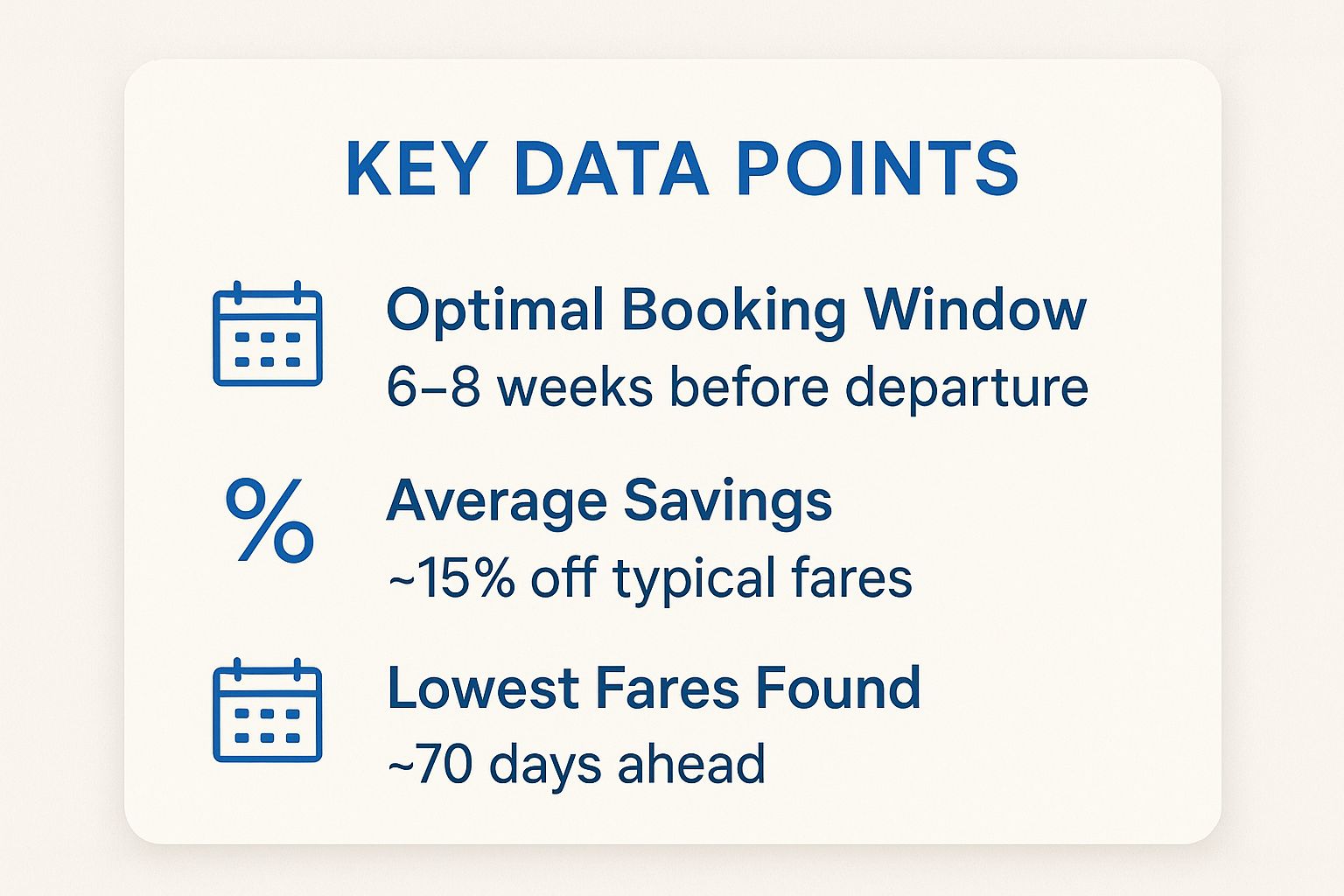
As you can see, the data points to a sweet spot around 70 days before your trip, where you could see savings of around 15%.
Actionable Tip: Focus on when you book in relation to your departure date, not the day of the week you buy the ticket. Prioritizing the booking window will consistently lead to better deals.
Of course, booking the flight is just one piece of the puzzle. While you're hunting for deals, take a moment to consider protecting your trip. A practical next step is to get a quote for short-term international travel insurance to cover any unexpected travel disruptions.
Optimal Flight Booking Windows at a Glance
To make it even simpler, here's a quick cheat sheet summarizing the ideal booking windows for different kinds of trips. Use this as a starting point for your flight search.
Travel Type | Optimal Booking Window (Days Before Departure) | Best Day to Depart |
|---|---|---|
Domestic Flights | 28-90 days (1-3 months) | Wednesday or Thursday |
International Flights | 60-240 days (2-8 months) | Weekdays (Tue, Wed, Thu) |
Holiday Travel (e.g., Christmas) | 90-180 days (3-6 months) | Off-peak days (e.g., the holiday itself) |
Spring/Summer Peak Season | 90-150 days (3-5 months) | Midweek |
Think of these as guidelines, not rigid rules. The most important action you can take is to start looking early and be prepared to book when you see a price that fits your budget within these windows.
Finding the Domestic Flight Booking Window
Booking a domestic flight follows a predictable pattern. Prices start high, drop into a ‘prime booking window’ as airlines compete for your business, and then skyrocket as the last few seats get snatched up. Your goal is to buy during that competitive dip.
Nailing this timing is your best strategy for saving money on domestic flights. Unlike international journeys that demand months of planning, the sweet spot for trips within the U.S. is much closer to your departure date. There's no need to plan six months out; in fact, you'll likely pay more if you do.

The Ideal Timeframe for Domestic Bookings
For most domestic flights, the prime booking window opens around three months before departure and closes about one month out. Consistently, data shows that fares booked within this 1-to-3-month period are the lowest you'll find.
Book any earlier than 90 days, and you're often paying a premium for being overly organized. Wait until the last 30 days, and you're gambling with steep price hikes.
Actionable Tip: To hit the sweet spot, aim to book roughly 45 to 60 days before your trip. This timeframe typically offers the best balance of great prices and a good selection of seats and flight times.
Of course, this window can shift based on your destination and travel dates. High-demand periods like holidays or spring break require a different strategy. For those popular times, you must book earlier. If you need a hand with that, check out our guide on how to book affordable flights during peak seasons for more specific advice.
Navigating High-Demand Travel Periods
Big events and holidays change the booking game. The standard 1-to-3-month rule doesn't apply when everyone is trying to fly to the same place at the same time.
Here’s a quick action plan for timing these popular domestic trips:
Major Holidays (Thanksgiving, Christmas): Start searching 3-6 months in advance. The booking window is much earlier, and prices will only climb the longer you wait.
Spring Break: Aim to book by late January or early February. If you wait until March, you're almost guaranteed to overpay as student demand peaks.
Major Events (Super Bowl, Music Festivals): The second the dates are announced, start tracking fares. The booking window is extremely short and competitive.
Let’s make this real. For a family trip from Chicago to Orlando in October, booking in August is perfect. But for the same trip during Christmas week, you must book by September at the latest. Waiting until November for that holiday flight is a costly mistake—airlines know demand is guaranteed and have no reason to lower fares. Being proactive is the key to not overpaying.
Mastering International Flight Bookings
Booking an international flight requires a different strategy than a quick domestic trip. You can't just hop online a few weeks before and expect a good deal. The process is more complex due to airline alliances, currency fluctuations, and global travel patterns that cause prices to swing wildly.
This means the booking window for a domestic flight is far too short for an overseas journey. You need to plan further ahead.

Finding the International Sweet Spot
For international adventures, start seriously looking six to eight months in advance. Your goal should be to book your ticket no later than two months before you take off. This long-range planning is crucial, as there are often fewer flights and less competition on long-haul routes.
The perfect window can shift depending on your destination. While domestic flights in the U.S. often hit their lowest price around 38 days out, international fares tend to bottom out closer to 50 days ahead. Flying to Europe? That window opens even earlier, with the sweet spot often landing around 94 days before departure. You can always dig into more detailed flight booking data to get a feel for your specific route.
Actionable Tip: Don't wait for last-minute international deals. They are extremely rare for popular overseas destinations. Booking late is almost always a costly mistake.
The Power of Shoulder Season Travel
One of the most effective strategies for saving money is to travel during the shoulder seasons—the periods just before or after the peak tourist season. Think of it as visiting a popular beach in May or September instead of the crowded and expensive month of July.
By targeting these off-peak times, you get two key benefits:
Cheaper Flights: Airlines slash prices to fill seats when demand is lower.
Lower Destination Costs: Hotels, tours, and even restaurants are often more affordable.
A Real-World Paris Scenario
Let's put this into practice with a trip to Paris.
For a week-long vacation in mid-July (peak season), a flight could easily cost $1,500 or more. You'll also face massive crowds at major attractions.
Now, shift that same trip to late September, a beautiful shoulder season month. That flight price could drop to $800 or even less. The weather is still pleasant, the summer crowds have gone home, and you get a more authentic and relaxed Parisian experience.
By simply adjusting your dates, you can save a significant amount of money and likely have a better vacation. Use this playbook for your next global adventure.
Choosing the Cheapest Days to Fly
While the day you buy your ticket doesn't matter much, the day you fly can make a huge difference to your budget. Shifting your travel dates by just a day or two is one of the easiest and most effective ways to cut your flight costs.
The reason is simple supply and demand. Leisure travelers tend to fly out on Fridays and return on Sundays, while business travelers often fly on Mondays and Fridays. This creates a sweet spot mid-week where demand dips, and airlines offer lower fares to fill empty seats.
The Midweek Advantage
Across the board, for both domestic and international trips, Tuesdays and Wednesdays consistently emerge as the cheapest days to fly. Choosing these days can lead to significant savings compared to traveling on a weekend, simply because you are competing with fewer people for seats.
Actionable Tip: When you start your flight search, select "flexible dates" if possible. Always check prices for a Tuesday or Wednesday departure to see an immediate comparison of potential savings.
This pattern applies to your return flight as well. Flying home on a Tuesday or Wednesday is typically cheaper than joining the Sunday rush. These small adjustments can free up more cash for your actual trip.
Surprising Weekend Sweet Spots
While midweek is usually the safest bet, there are exceptions. For domestic travel, Saturday can be an unexpected source of deals. Most weekend travelers depart on Friday and return on Sunday, which can leave Saturdays with lower demand and, consequently, lower prices.
Data from airfare studies shows these patterns can yield serious savings. For international travel, departing on a Thursday can save an average of 15%. For domestic trips, flying on a Saturday can be 17% cheaper. While these aren't ironclad rules, you can explore more airfare study results to see how much flexibility can pay off.
The day of the week isn't the only factor. To further reduce costs, use these two timing strategies:
Fly Early Morning: The first flights of the day are often cheaper because fewer people want to wake up that early. Airlines discount these less desirable slots to fill them.
Fly Late Night: Similarly, late-night "red-eye" flights are another excellent way to save. If you can sleep on the plane, you can often secure some of the lowest fares available.
To give you a clearer picture, here's how your departure day can impact your wallet.
Typical Savings by Departure Day
This table shows the average cost difference based on the day you fly. Notice how weekends are generally pricier, while midweek offers the best value.
Day of the Week | Domestic Flight Cost (vs. Average) | International Flight Cost (vs. Average) |
|---|---|---|
Monday | About 4% higher | About 2% cheaper |
Tuesday | About 12% cheaper | About 11% cheaper |
Wednesday | About 14% cheaper | About 13% cheaper |
Thursday | About 6% cheaper | About 15% cheaper |
Friday | About 7% higher | About 3% higher |
Saturday | About 17% cheaper | About 5% cheaper |
Sunday | About 11% higher | About 6% higher |
As you can see, the savings are significant. A little planning around your departure day can easily keep hundreds of dollars in your pocket, especially when booking for a group.
Actionable Tools to Find the Best Prices
Knowing the best time to book is half the battle; using the right tools is the other half. Let's move from theory to practice with powerful online tools that automate the hunt for cheap flights.
These tools act as your personal flight-finding assistants, working 24/7 to pinpoint the best deals so you don't have to.
Instead of manually checking fares every day, set up price alerts on platforms like Google Flights or Skyscanner. This simple action lets the deals come directly to you. It’s the difference between guessing when to buy and getting a notification the moment a great price appears.
Here’s how easy it is to track prices on Google Flights. With one click, you can activate email notifications and let the platform do the work.

This feature empowers you to act decisively when a fare drops into your prime booking window, taking the guesswork out of the equation.
Leveraging Price Graphs and Fare Calendars
Most flight search engines offer visual tools that help you spot the cheapest travel periods at a glance. Use them to your advantage.
Fare Calendars: These provide a month-long view, often color-coding days with the lowest prices. It's the fastest way to see if shifting your trip by a day or two could slash your costs.
Price Graphs: This tool shows you how the fare for your trip has changed over time, giving you a good idea of whether today's price is a bargain or if you should wait for a potential drop.
Actionable Tip: Combine these tools for maximum savings. Use the calendar to find the cheapest week to travel, then set a price alert for those specific dates. This two-step process is how you find the absolute lowest fare.
Step-by-Step Guide to Setting a Fare Alert
Setting up an alert takes just a minute but can save you hundreds. Here's how to do it on Google Flights:
Enter Your Route and Dates: Input your departure and arrival cities, along with your preferred travel dates.
Find the "Track Prices" Toggle: Look for a button or switch near the top of the search results labeled "Track prices."
Activate the Alert: Click it. If you're logged into your account, you will automatically start receiving emails whenever the price for that flight changes significantly.
By taking this proactive approach, you become a strategic deal-finder instead of a passive searcher. For an even deeper dive into more advanced tactics, check out our guide on how to find the best deals on airfare.
Armed with these tools, you're equipped to take control and make sure you never overpay for a flight again.
Common Flight Booking Myths Debunked
Bad advice costs money, and the world of flight booking is full of it. Sticking to outdated strategies is a surefire way to miss out on deals. Let’s dismantle the most common myths so you can focus on what actually works.
One of the most persistent myths is that searching in incognito or private browsing mode will show you lower prices. This is false. Airline pricing is driven by real-time supply and demand, not your browser history. When a fare changes, it’s because seats were sold or added, not because an airline is tracking your searches.
Challenging the Last-Minute Deal Fantasy
Another tempting but risky myth is the "last-minute deal." While you might occasionally find a cheap domestic flight a week out, for most trips—especially popular or international routes—this is a losing strategy.
Airlines know that last-minute travelers are often business flyers or people with urgent needs who are willing to pay more. They typically raise prices on the last few seats rather than discount them.
Actionable Tip: Don't wait for a last-minute miracle. The most reliable way to overpay is to book in the final weeks before departure. Stick to the prime booking windows outlined in this guide for consistent savings.
Many of these misconceptions can lead you down the wrong path. We dive deeper into this in our guide debunking the travel myths about the cheapest days to travel.
By understanding why these myths don't hold up, you can stop wasting time on tactics that don't work and instead focus your energy on proven strategies like booking in the sweet spot and setting up fare alerts.
Your Top Flight Booking Questions Answered
Even with a solid plan, questions can arise. Here are answers to some of the most common queries to help you book with confidence.
One-Way or Round-Trip: Which Is Cheaper?
The answer depends on your destination. For international trips, round-trip tickets are almost always cheaper. Legacy airlines structure their international fares to reward travelers who book a clear return journey.
For domestic travel, you can often save money by booking two separate one-way tickets, sometimes on different airlines. This approach, driven by budget carriers, can offer more flexibility and lower costs. Your best bet is to always price it out both ways before you buy.
How Far Ahead Should I Book Holiday Flights?
Holiday travel, like for Christmas and Thanksgiving, operates on its own timeline. High demand means you must book much earlier than usual.
Start your search 3-6 months in advance, and aim to have your tickets confirmed at least two or three months before you fly.
Actionable Tip: Last-minute deals for major holidays do not exist. If you wait, you will pay a massive premium for one of the last few seats on the plane. Book early.
Once your flight is booked, a little airport prep can reduce stress. If you're flying through New York, for example, a practical JFK Airport Guide can help you navigate the terminals smoothly.
Do Airlines Jack Up Prices if I Keep Searching the Same Route?
This is a major myth. The short answer is no. Airlines use dynamic pricing systems that adjust fares based on real-time supply and demand across all users, not your individual search history.
Prices change constantly based on how many seats are left and how many people are looking at them at that moment. If you see a price you're happy with inside the sweet spot booking window, book it. Waiting for it to drop again is a gamble that rarely pays off.
Ready to put these strategies into action? At Oafare, Inc., we make it easy to find and compare the best deals from hundreds of airlines in one simple search. Stop guessing and start saving on your next adventure. Find your cheap flight on Oafare, Inc. today!
Article created using [Outrank](https://outrank.so)

Comments